
March 2026 - Texas Market in General

Rates, Statistics & Market Outlook for Investors
March 2026 | Data through Q4 2025
Market Snapshot
The numbers tell a clear story: Texas is a market in transition. Here are the key figures shaping investor decisions right now.


Sources: TRERC, Redfin, ATTOM Data Solutions
Mortgage Rates: Where We Are and Where We're Headed
Current 30-year fixed mortgage rates in Texas are hovering near 6.65%, remaining stubbornly elevated despite widespread expectations of easing. The Federal Reserve has signaled a measured approach to rate cuts in 2026, with the Fed Funds target projected to settle in the 3.0% to 3.5% range by year-end. This would put downward pressure on mortgage rates, though the path will not be linear.
The Texas Real Estate Research Center (TRERC) projects that 30-year fixed rates could decline to the 5.0% to 5.6% range by December 2026. If that forecast holds, it would meaningfully improve monthly payment affordability and release pent-up demand from buyers who have been waiting on the sidelines. For context, every 1% drop in rates increases a buyer's purchasing power by roughly 10%, which could shift demand dynamics significantly in the second half of the year.
However, investors should plan for a range of scenarios. Persistent inflation, geopolitical uncertainty, or a slower-than-expected Fed easing cycle could keep rates elevated through mid-2026. The base case is gradual improvement, not a dramatic drop.
Source: TRERC 2026 Texas Real Estate Forecast, Federal Reserve projections.
Home Prices and Inventory: A Buyer's Market Takes Shape
Texas home prices are softening. The statewide median sale price in January 2026 was $329,500, down 1.2% year-over-year. In December 2025, prices were down approximately 2.7% annually, with TRERC projecting a modest recovery to around $334,000 by year-end 2026, representing just 1.3% growth.
The real story is inventory. Months of supply has expanded to 5.5 months statewide as of late 2025, up from 4.7 months a year earlier and well above the three-to-four-month range that typically characterizes a balanced market. This excess supply is handing negotiating leverage to buyers and forcing sellers into price reductions and concessions across the state.
Metro-Level Price Performance
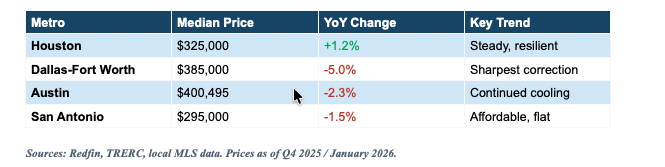
Sources: Redfin, TRERC, local MLS data. Prices as of Q4 2025 / January 2026.
Dallas-Fort Worth recorded the sharpest correction with a 5% decline in home values across 2025. Austin continues to cool from its pandemic-era highs, though it remains the most expensive major Texas metro. Houston has proven the most resilient, posting modest gains even as surrounding markets pulled back. San Antonio remains the most affordable entry point for investors, though demand has been relatively flat.
Sales Volume and Days on Market
Statewide home sales dropped 8% year-over-year heading into late 2025, reflecting the combined weight of elevated mortgage rates and affordability constraints. TRERC forecasts a modest 2.5% rebound in 2026 to approximately 349,000 total sales (new and existing homes), contingent on rates declining as projected.
Days on market have stretched considerably. The median sold home now sits on the market for approximately 85 days, while unsold inventory lingers for an average of 103 days. This extended timeline creates opportunity for investors who can move quickly and negotiate from a position of strength, particularly on properties that have been listed for 90 days or more where seller motivation increases significantly.
Over half of Dallas-Fort Worth listings have undergone at least one price reduction, and Austin leads the state with 53.4% of active listings reducing their asking price. This pricing pressure is a direct result of the inventory overhang and signals that sellers are adjusting expectations to meet the current market reality.
Why the Market Is Shifting: Key Drivers
Affordability Squeeze
The combination of elevated mortgage rates and home prices that appreciated 40-60% during the pandemic era has pushed many buyers to the sidelines. Even with modest price declines, monthly payments remain significantly higher than they were three years ago. Texas benefits from no state income tax and relatively lower costs of living, but affordability is still a headwind, particularly for first-time buyers.
Inventory Surge from New Construction
Texas builders have continued to deliver new inventory aggressively, particularly in suburban markets around Houston, Dallas-Fort Worth, and San Antonio. This new supply is competing directly with existing homes, putting downward pressure on resale values and giving buyers more options. Builder incentives including rate buydowns, closing cost credits, and price reductions have become standard practice across most developments.
Population and Job Growth Remain Supportive
Despite the near-term cooling, Texas continues to attract domestic migration at one of the highest rates in the nation. The state added over 470,000 residents in the most recent census estimates, driven by corporate relocations, favorable tax policy, and relatively affordable housing compared to origin states like California and New York. Major employers continue to expand, with notable activity in technology, energy, healthcare, and logistics sectors. This population growth provides a structural floor under housing demand.
Insurance and Property Tax Pressures
Rising insurance premiums, particularly in coastal and flood-prone areas, and escalating property tax assessments are adding to effective housing costs. In some Harris County submarkets, annual insurance premiums have increased 25-40% over the past two years, eroding affordability even for existing homeowners and contributing to distress in over-leveraged properties.